Battery Energy Storage (BESS) and Grid Independence: Solving Capacity Shortages in Hungarian Industrial Real Estate in 2026
The Hungarian industrial real estate market faces a dual challenge in 2026: while the vacancy rate in the Budapest agglomeration has risen to 12.8%, modern, energy-intensive manufacturing and logistics companies often cannot find sites with adequate power capacity. Grid capacity shortage has become one of the main recurring problems for developers and tenants alike. DLA Piper's 2026 real estate report also highlights this: due to the limitations of traditional grid connections, the focus has shifted to alternative energy models, especially "behind-the-meter" solutions and Battery Energy Storage Systems (BESS).
In this article, we examine how the energy crisis is transforming the leasing and development of industrial properties, and what a CEO needs to know before signing a long-term lease agreement.
Why Has Grid Capacity Become Critical by 2026?
In recent years, the Hungarian industrial real estate market has experienced explosive growth. According to the April 2026 report of the Hungarian National Bank (MNB), the modern industrial-logistics stock nationwide has swelled to approximately 18.2 million square meters. In 2026 alone, the handover of an additional 2 million square meters of new space is expected, 60% of which will be realized in Eastern Hungary (Debrecen, Kecskemét, Nyíregyháza, Szeged).
With this massive volume of development and the automation of industries (especially automotive and e-commerce), energy demand has skyrocketed. The problem is exacerbated by the following factors:
- Aging Infrastructure: The existing electrical grid in many industrial zones cannot handle the sudden peak demands of modern, robotic warehouses and high-performance production lines.
- Solar Feed-in Limits: Although solar panels have been installed on the roofs of many halls, the grid cannot always absorb the fed-back energy, making local consumption or storage of the generated electricity inevitable.
- ESG Expectations: Investors and multinational tenants have set strict sustainability goals (Net Zero), which requires the use of green energy, but green electricity purchased from the grid is often expensive or not available in sufficient quantities.
The Solution: BESS and "Behind-the-Meter" Systems
To overcome grid limitations, the most innovative logistics parks (such as HelloParks' megaparks in Fót and Alsónémedi, which are filling up at record speed despite high general vacancy) are already applying an integrated energy strategy.
What is a "Behind-the-Meter" (BTM) Solution?
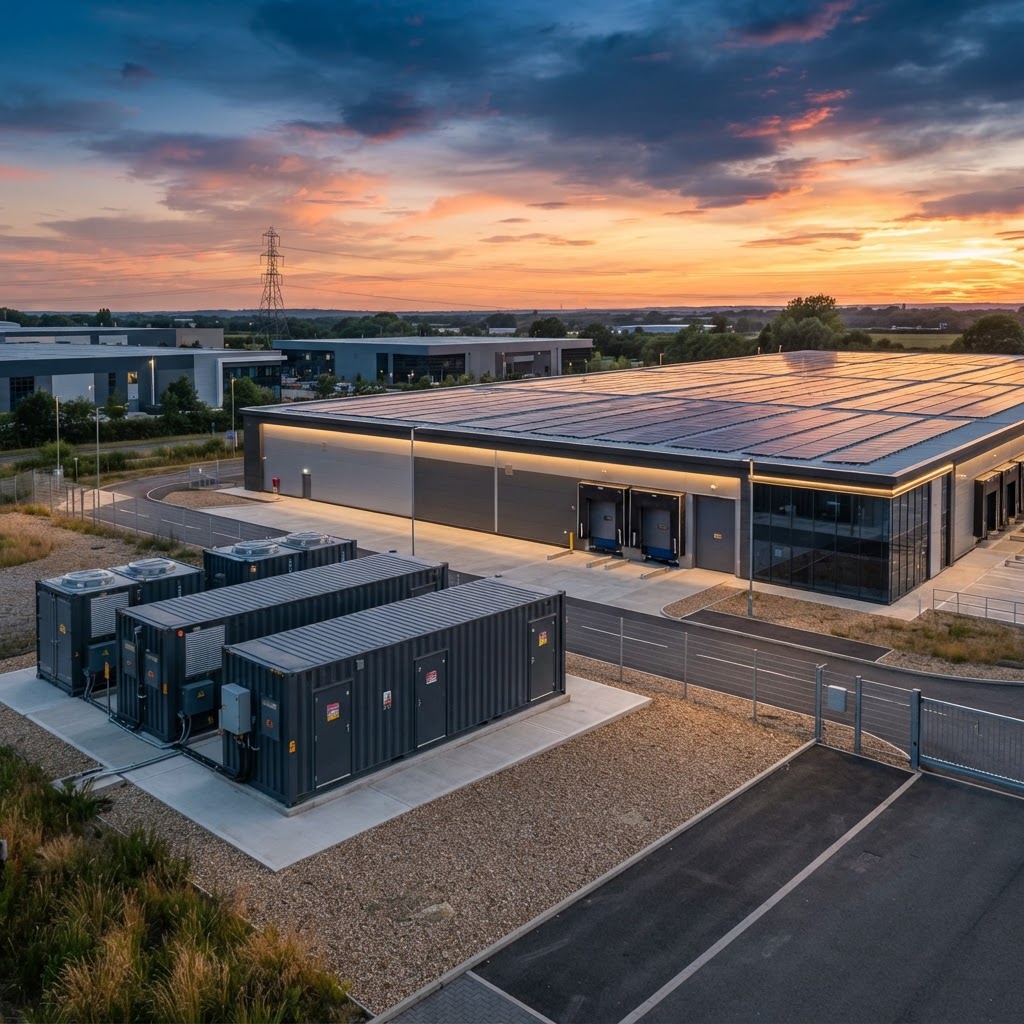
BTM systems are energy generation and storage units located on the consumer's (tenant's) side, behind the utility meter. This means that the company directly uses the energy it generates itself (for example, from roof-mounted solar panels) without it passing through the public grid. This avoids grid usage fees and capacity limits.
The Role of Battery Energy Storage (BESS)
BESS (Battery Energy Storage System) is the heart of BTM systems. Huge, industrial-scale lithium-ion or other technology batteries enable the following:
- Peak Shaving: When machines start up simultaneously, the sudden power draw (peak demand) incurs huge costs or can even trip the grid. BESS instantly supplements the missing energy from the batteries, so the spike in demand does not reach the grid.
- Load Shifting: The system stores cheap (or free) energy generated by solar panels during the day and uses it when grid electricity is most expensive, or when the sun is no longer shining (e.g., during a night shift).
- Uninterruptible Power Supply (UPS): In the event of a grid outage, critical systems (servers, cold stores, automated picking robots) can continue to operate smoothly.
Costs and Market Trends in 2026
According to MNB data, typical asking rents in the Budapest industrial-logistics market in early 2026 range between 4.95–5.95 EUR/sqm/month. Although rents have stabilized, operating expenses (OPEX) – including energy costs – drastically affect the Total Cost of Ownership (TCO) of a site.
The rent for a highly energy-efficient hall equipped with a BESS system might be 0.5-1 euro higher per square meter, but the tenant recovers this premium many times over through more predictable and lower energy costs, as well as the avoidance of production downtime.
According to the DLA Piper survey, compliance with ESG criteria has also become crucial during credit assessments. Developers who do not integrate energy storage solutions are finding it increasingly difficult to obtain financing, and tenants are also avoiding outdated, "brown" properties.
Decision Guide for CEOs: What to Look for Before Leasing?
If your company is looking for a new warehouse or production hall in 2026, examining the energy infrastructure is the most important step alongside location and rent. Here is a short checklist:
- Available Contracted Capacity: Exactly how much electrical capacity does the landlord guarantee in the contract? Is this sufficient for future machinery expansion?
- Expandability: If the grid cannot handle more load, is there physical space and legal possibility to install BESS containers on the plot?
- Solar Potential: Can the roof structure support solar panels? Who owns the right and cost of the investment (landlord or tenant)?
- Colocation Models: Are there solutions in the park where tenants can share generated energy among themselves (energy communities)?
Summary
In the 2026 Hungarian industrial real estate market, technological readiness and energy independence represent the greatest competitive advantage. Grid capacity shortage is not a temporary problem, but a new market reality, to which "behind-the-meter" systems and battery energy storage provide the most reliable answer.
Are you ready to find the most modern, energy-secure logistics center or industrial plot for your company? Visit Raktarak.com and use our detailed search engine to choose the perfect, future-proof site from the latest 2026 market offerings!
Tetszett a cikk? Kérje a következőt emailben
Piaci elemzések és friss ipari ingatlan ajánlatok — hetente egy levél.
Looking for or offering industrial property?
Browse our listings or ask a question — we reply within 1 business day.